
Image Courtesy: Photo by Cottonbro Studio
Summary:
To know whether a spin-off lifts the original show, look for three signals:
- An uplift in the original title's viewing after the spin-off launches
- Whether that uplift holds beyond launch week
- The size of the audience overlap between the two titles.
Introduction:
If a spin-off is meant to strengthen a franchise, a revealing test is to see whether it changes behaviour around the original title. If viewers return to the source series after the new release arrives, the franchise may still be working as a connected whole. If they do not, then the newer title may be attracting attention without lifting the wider catalogue.
Why this matters
A spin-off can succeed on its own and still tell you very little about franchise strength.
Launch numbers show whether the new title found an audience. They do not show whether the wider franchise gained momentum as a result. That is the gap teams need to close when they are assessing catalogue value, franchise durability, and what a new release actually changed.
The three signals to look for
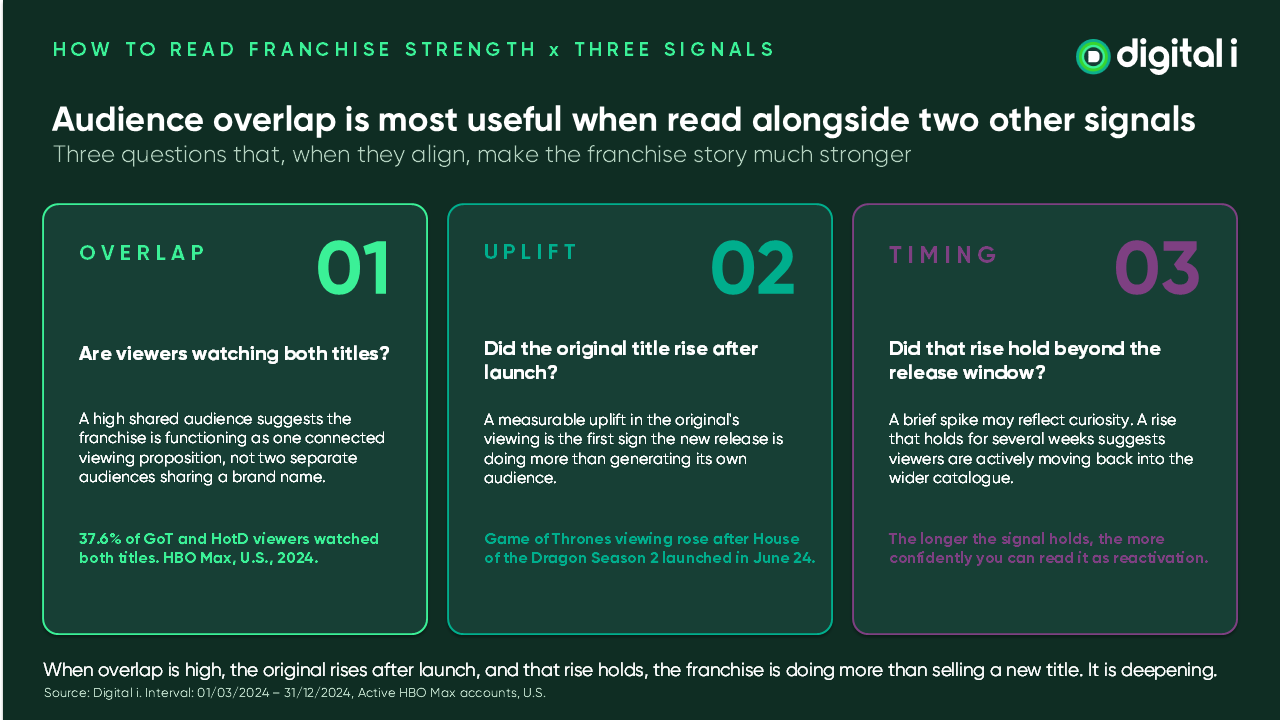
1. Uplift in the original title
The first thing to measure is whether viewing to the original title rises after the spin-off launches. That is the clearest first sign the new release is doing more than generating its own audience.
2. Timing of that uplift
Timing matters just as much as uplift. A brief rise around launch may reflect curiosity. A stronger signal is one that holds beyond the release window. That suggests viewers are not only sampling the spin-off. They are moving back into the wider catalogue.
3. Audience overlap
Overlap helps show whether viewers are moving between the original and the extension. A large, shared audience often points to something more valuable than launch demand alone. It suggests the franchise is still functioning as a connected viewing proposition.
What the data shows
The clearest example in Digital i's analysis is Game of Thrones and House of the Dragon. In the U.S. on HBO Max, Game of Thrones viewing rises after House of the Dragon Season 2 launched in June 2024. The overlap data strengthens that read. Across the period shown, 37.6% of viewers watched both titles, compared with 25.1% who watched only Game of Thrones and 37.3% who watched only House of the Dragon. That looks less like two separate audiences and more like a sizable, shared viewer base moving between old and new.
The Bridgerton and Queen Charlotte pairing points in the same direction. Bridgerton rose sharply around the release of Queen Charlotte in May 2023, then stayed above its earlier baseline for a period afterwards rather than dropping straight back. That suggests more than a launch-week spike.
How to use this in practice
If you want to know whether a spin-off lifted the original title, do not stop at the new release's audience.
- Check whether the original rose.
- Check whether that rise held.
- Check whether viewers moved across both titles.
Want a clearer way to assess franchise strength beyond launch performance? Speak to Digital i about how behavioural audience data can help you measure catalogue re-engagement.

.jpg)