Image Credits: Kaboompics
On 20 October, Netflix reported its Q3 2026 earnings, and the market wasn’t convinced. Revenue grew 12% to $12.9 billion and operating income rose 37%, yet shares fell more than 5% in after-hours trading. Revenue growth slowed for another quarter, and Netflix cut its 2026 advertising revenue forecast.
Much of the coverage that followed zeroed in on engagement, and Netflix raised the issue itself. In its letter to shareholders, the company acknowledged “investor concern about our view hours growth” and admitted there was more work to do to grow viewing hours.
The conclusion many have drawn is simple: Netflix has an engagement problem. Our viewing data tells a more nuanced story. Yes, the average account is watching less. But more people are watching, and a growing share of that viewing is happening on the one plan where every extra minute can be turned into revenue.
Yes, each account is watching less
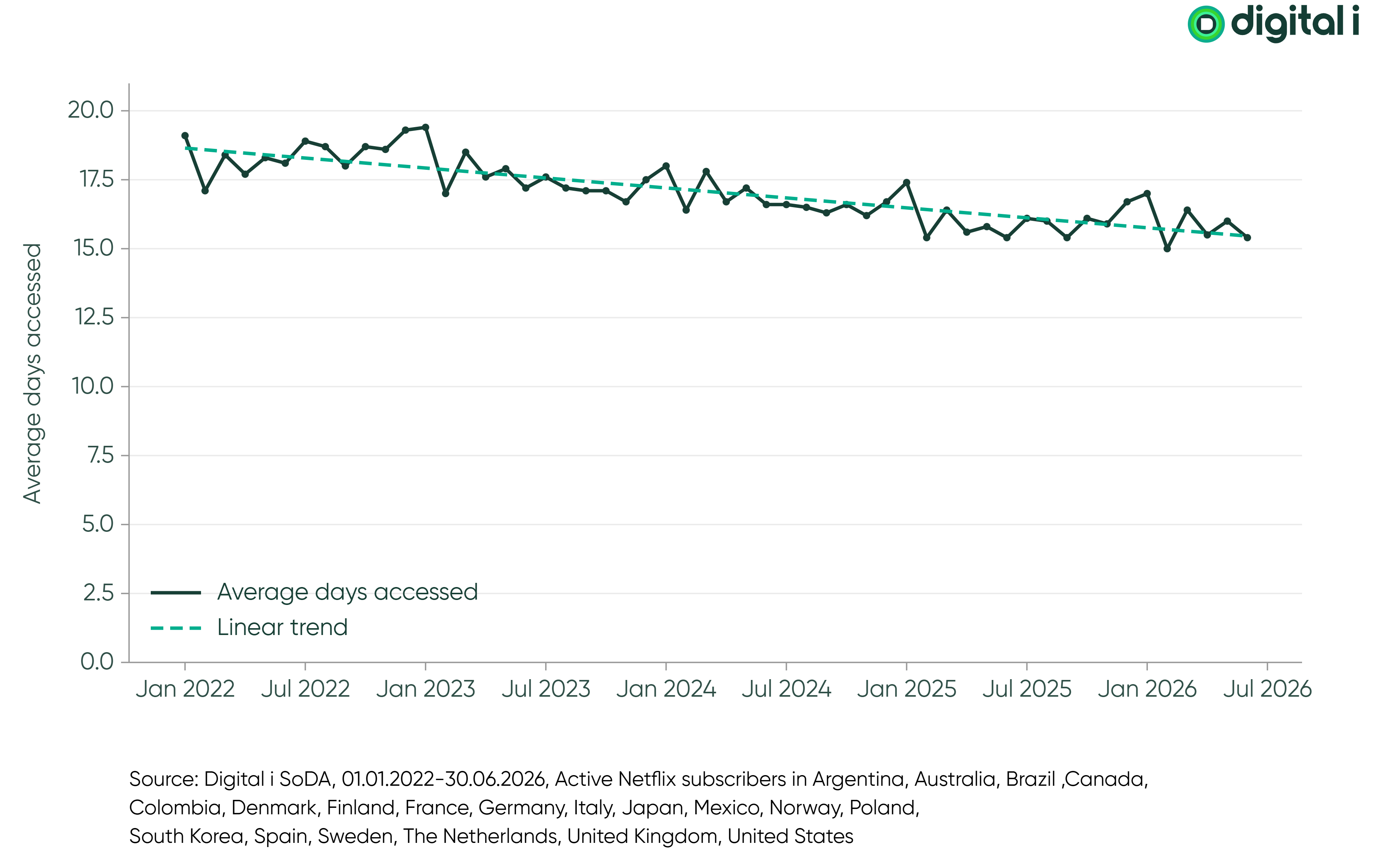
Across the 20 markets Digital i’s SoDA (Streaming on Demand Analytics) panel covers, the average Netflix account opened the service on 18.7 days a month at the start of 2022. By mid-2026, that had fallen to 15.5 days.
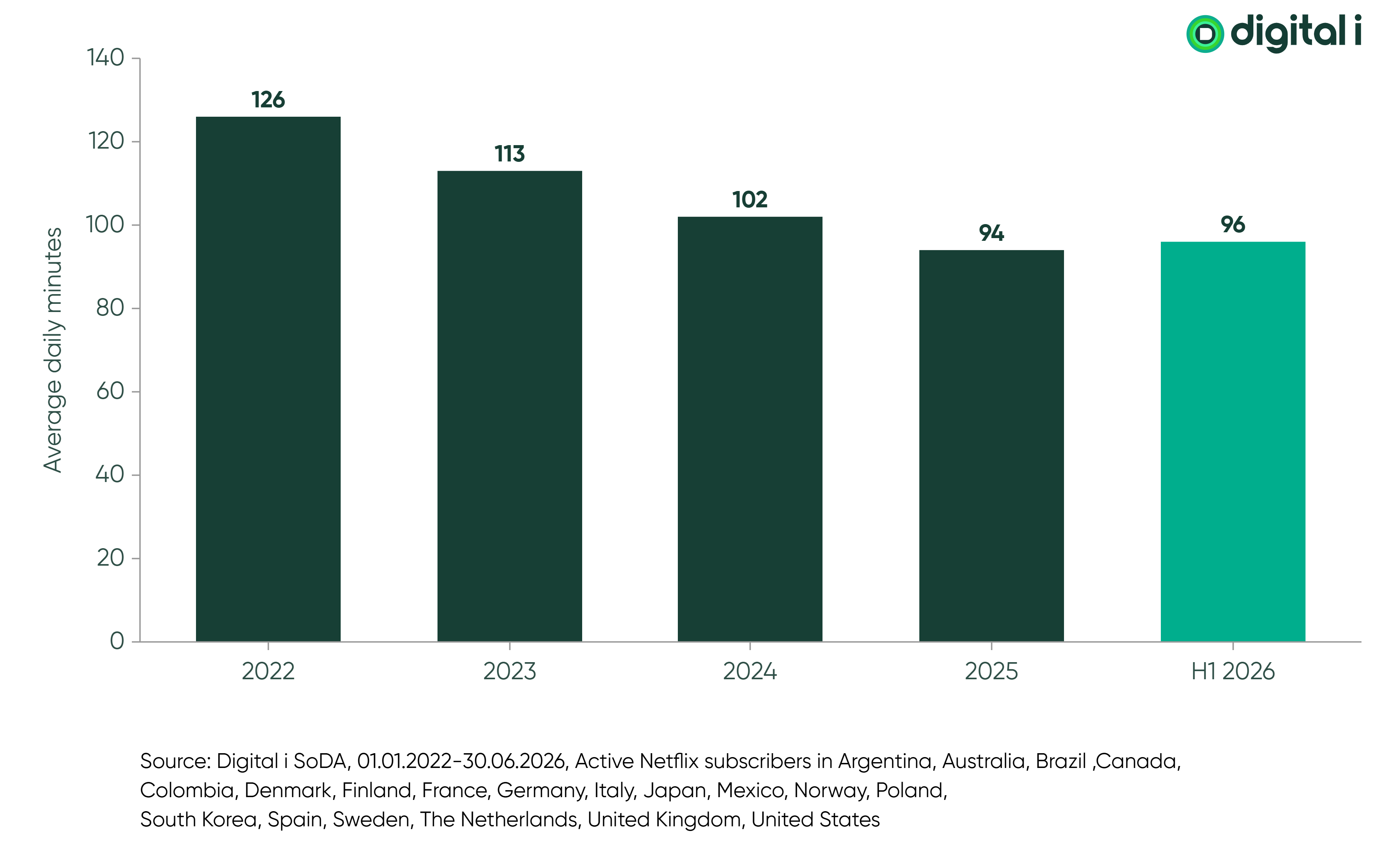
Time spent on the platform tells us a similar story. Average daily viewing time is down from 126 minutes in 2022 to 96 in the first half of 2026. But the decline appears to be levelling off; in fact there was a minor increase from 2025 to H1 2026. Average days accessed has remained fairly consistent since early 2025.
But, the subscriber base keeps growing
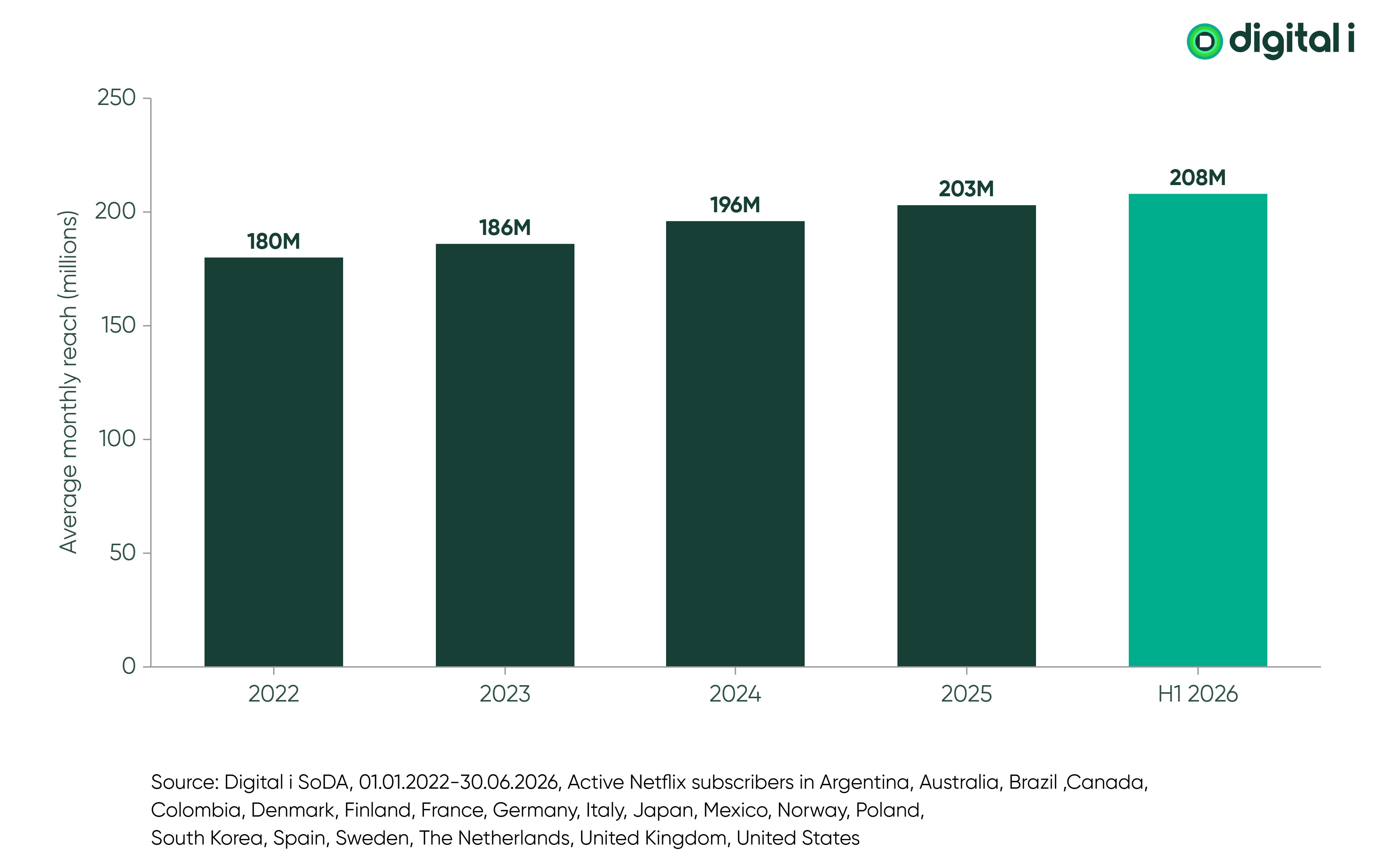
Average viewing per account only tells half the story. Over the same period, Netflix’s average monthly reach grew every single year, from 180 million in 2022 to 203 million in 2025, and 208 million in H1 2026. That’s roughly 6–10 million more viewers a year. This is no coincidence.
Netflix rolled out its password sharing crackdown in Latin America in 2022 and across more markets in 2023, turning millions of borrowers into paying subscribers. Viewing that used to happen on one shared account is now spread across several, so it’s no surprise that time per account has dropped.
The ad tier’s share of Netflix viewing has more than doubled since 2023
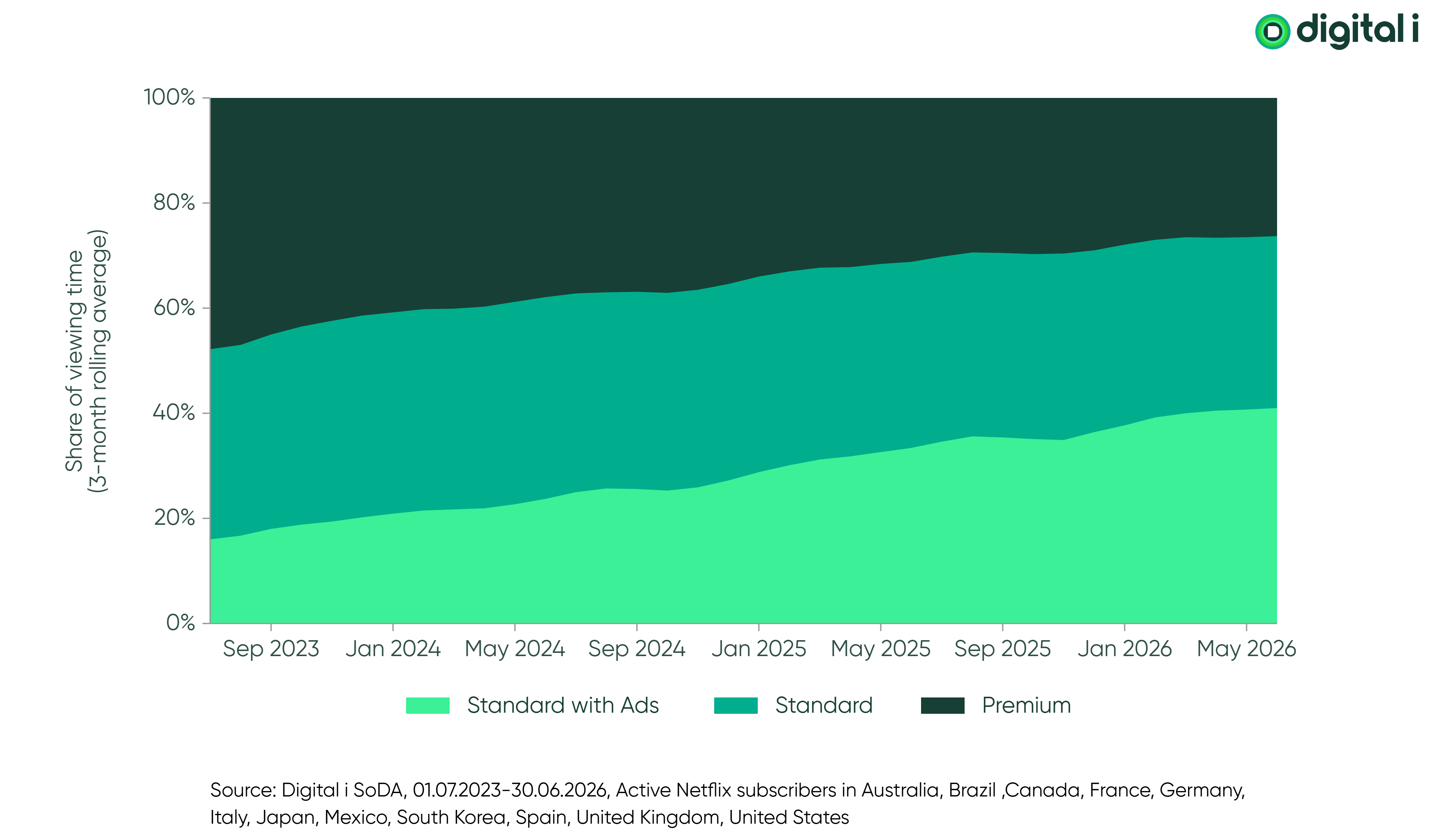
In the 12 SoDA markets where Netflix offers an ad-supported plan, Standard with Ads accounted for 16.1% of all Netflix viewing time in mid-2023. By June 2026 it accounted for 41.0%. The cheapest plan type now drives a higher proportion of viewing than any other.
Most of that gain came at Premium’s expense, whose share of viewing fell from 47.8% to 26.3%. Meanwhile, Standard accounts have fairly consistently accounted for around a third of viewing time.
Ad-tier accounts are catching up

More Netflix subscribers are choosing the cheaper plan with ads, especially people joining for the first time. But that’s only part of the reason the ad plan now accounts for more of what people watch on Netflix. People on the ad plan are also watching more. Between H2 2023 and H1 2026, the average Standard with Ads account went from 68.5 to 80.7 minutes of viewing a day, up 18%. Over the same period, accounts on Premium, Netflix’s most expensive plan, dropped from 143.5 to 121.6 minutes a day, down 15%.
In late 2023, Premium accounts watched 75 minutes a day more than ad plan accounts. Now the difference is just 41 minutes, almost half what it was.
This is the point most coverage misses. On an ad-free plan, an extra hour of viewing doesn’t directly contribute to increased revenue. On the ad tier, every extra hour watched is more advertising inventory Netflix can sell. So while overall engagement has softened, engagement is growing on the one plan where more viewing can be turned into more revenue.
What to watch next
None of this means Netflix can relax. Revenue growth is slowing, from around 17% at the end of 2025 to 12% in Q3 2026. Alongside its Q3 results, Netflix cut its 2026 advertising revenue forecast to about $2.7 billion from roughly $3 billion. Looking to bring in more advertising revenue, Netflix recently announced that it will be rolling out ad-supported streaming in 15 more countries in 2027.
Netflix doesn’t have an engagement problem so much as a monetisation challenge. The viewers are there, and increasingly on the ad tier. The 2027 expansion will show whether it can make those hours pay. With both Squid Game and Stranger Things now wrapped, Netflix needs its next big hit to keep subscribers coming back. Its next breakout hit won’t just drive conversations. It’ll drive the numbers too.
Subscribe to the Digital i newsletter to stay connected with our latest analysis, reports and insights from the media and entertainment industry.