

%20(1).jpg)
Image Courtesy: Photo by Dex Ezekiel
In 2025, Australian subscribers spent 96.4% of their Netflix viewing time on international content. South Korean subscribers spent 63.9% of their viewing time on local productions. Japanese subscribers spent 57.0%.
Those three numbers describe three different kinds of streaming markets. Australia consumes Netflix predominantly as a service for international content. Korea and Japan consume it more as a domestic platform, with international titles complementing the local titles which make up a majority of viewing time.
When you look at four signals together; reach, new subscriber sign-ups, completion, and travelability, local content does not just lead in Korea and Japan. It leads on every measurable form of value.
How local content wins the audience
Korea's four highest-reaching Netflix titles in 2025 were When Life Gives You Tangerines (7.7 million subscribers reached), The Trauma Code: Heroes on Call (7.2 million), KPop Demon Hunters (6.9 million), and Squid Game (6.7 million). All locally produced or Korean-cultural in origin. Japan's top three were Bullet Train Explosion (5.6 million), The Apothecary Diaries (4.2 million), and Last Samurai Standing (4.1 million). All Japanese productions. Australia's top four were Adolescence, Happy Gilmore 2, Wednesday, and Stranger Things, reaching between 3.6 and 4.1 million each. All imports.
The sign-up data shows the same pattern more sharply. Looking at the first title, a new subscriber watched after joining, which is a useful proxy for what brought them to the platform, Korea's top sign-up drivers were The Trauma Code: Heroes on Call (266,000 first streams), When Life Gives You Tangerines (235,000), and Squid Game (203,000). Japan's top was Tokyo Swindlers (155,000), then Squid Game (133,000), then How Do You Like Wednesday? (77,000). Australia's was Emily in Paris (36,000).
New Korean subscribers were watching local content first at roughly seven times the volume new Australian subscribers were watching their top import.
And local content holds the audience too
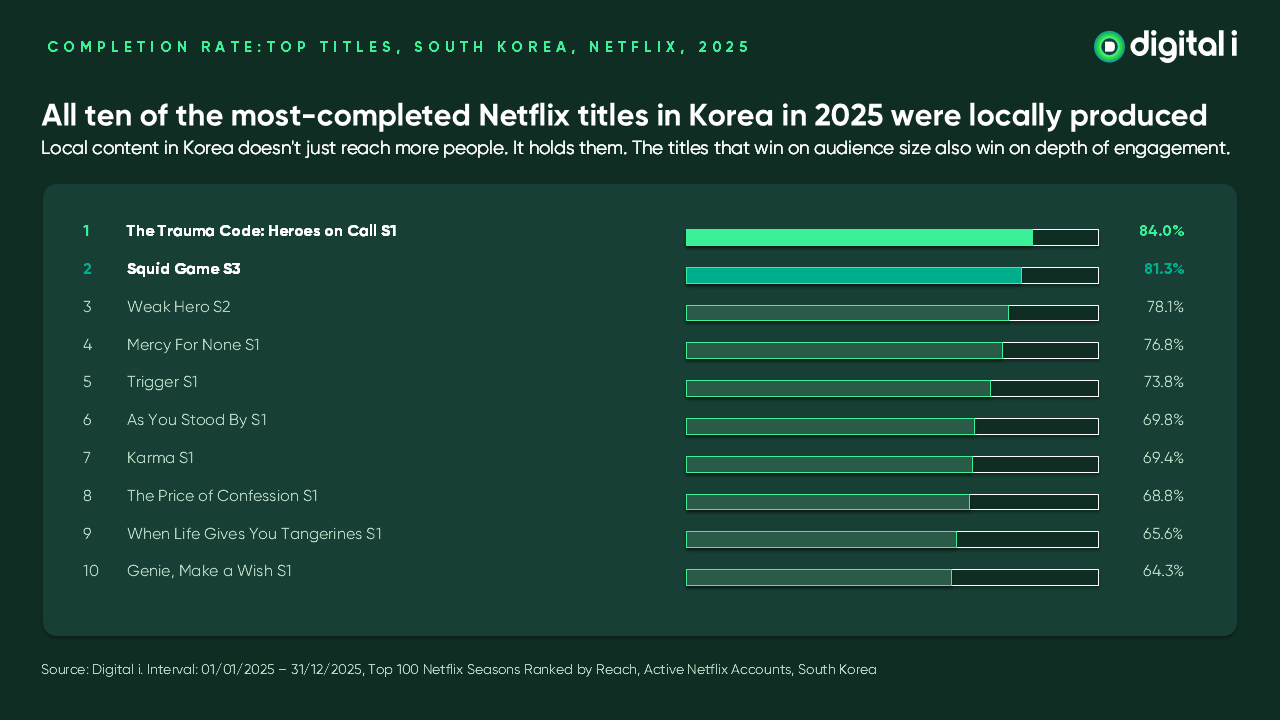
Reach and sign-ups describe how many people start watching. Completion describes how many of them finish.
In Korea, all ten of the most-completed Netflix titles in 2025 were locally produced. The Trauma Code: Heroes on Call topped the list at 84.0%, meaning 84 of every 100 accounts that started the show went on to finish it. Squid Game sat at 81.3%. The remaining eight, from Weak Hero (78.1%) down to Genie, Make a Wish (64.3%), were all Korean originals.
The same titles that win Korea on reach and acquisition also win on engagement. The catalogue's strongest performers do every job a streaming title can do, and they do it locally.
And in one case, the local title travels globally
Korea also exports content at scale. In 2025, Korean content was viewed for approximately 10 billion hours outside South Korea across the 16 measured markets. Japanese content generated 7.3 billion hours of outbound viewing. Australian content generated 1.3 billion.
Squid Game alone accounted for 1.5 billion of Korea's outbound hours, or 15.2% of the total. No other Korean title approached that scale of travel. But the remaining 8.5 billion hours of Korean outbound viewing show the flow isn't a single-title phenomenon. Korean content travels broadly, and one Korean title travels at a scale that places it alongside the most-discussed Western releases.
What this looks like together
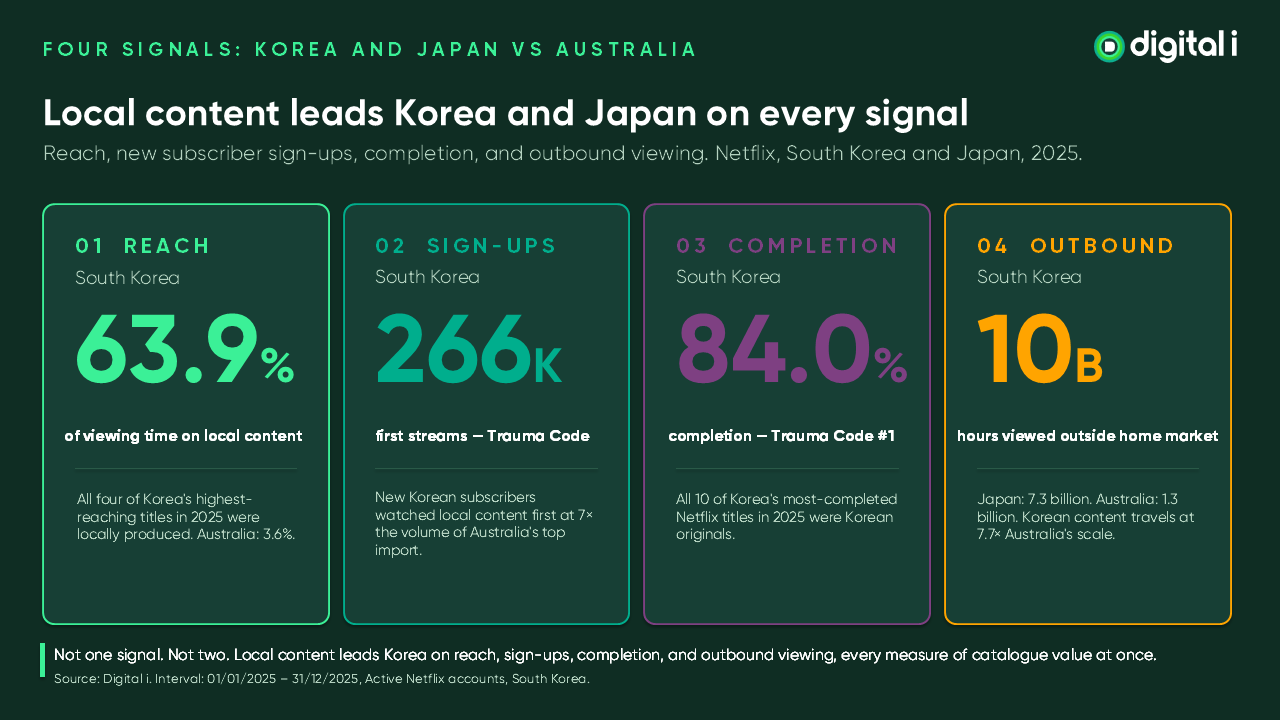
The framing that explains streaming value in Australia, where a small number of internationally recognised hits dominate viewing, does not describe what is happening in Korea and Japan. In those markets, value distributes differently. Local content sits at the top of every ranking, and one of those local titles is also doing the kind of cross-border reach that is typically associated with Western IP, where shared language and cultural familiarity have historically made international travel easier.
Digital i works with global streaming and content strategy teams on questions like these, across SoDA's full set of measured markets.

.jpg)


