Image Courtesy: Photo by Tech Daily
Netflix's official YouTube channel reached 31.6 million accounts in the United States in 2025. Among the top ten highest-reaching YouTube channels in the U.S. that year, that placed it fifth.
Reach and engagement are different signals
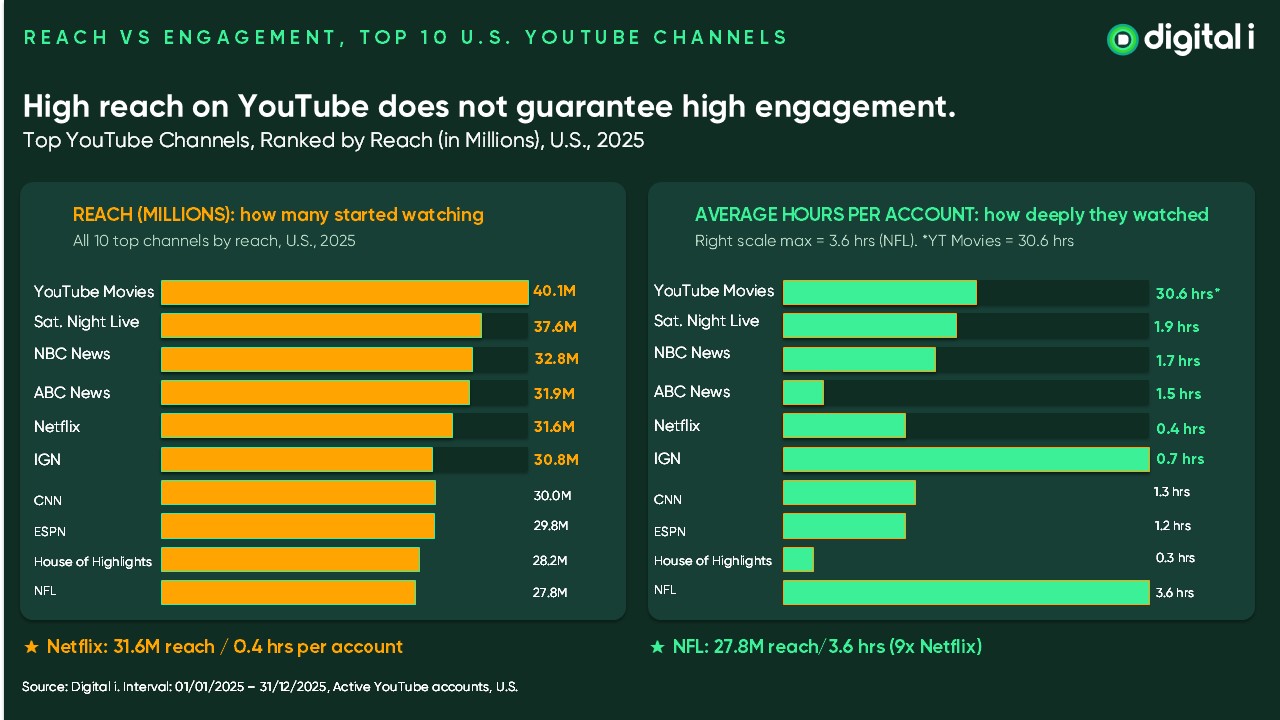
The top ten U.S. channels by reach in 2025 were Saturday Night Live, NBC News, ABC News, Netflix, IGN, CNN, ESPN, House of Highlights, the NFL, and YouTube Movies. Established brands, large distribution footprints, significant marketing investment. All of them reached between 27.8 million and 40.1 million accounts.
Only two of those ten channels averaged more than two hours per account viewing time per year. YouTube Movies is its own structural outlier, a free streaming destination rather than a brand channel. It reached 40.1 million accounts and generated 1,225.6 million hours viewed, averaging 30.6 hours per account. The NFL reached 27.8 million accounts and averaged 3.6 hours per account. Every other channel in that top ten averaged between 0.3 and 1.9 hours.
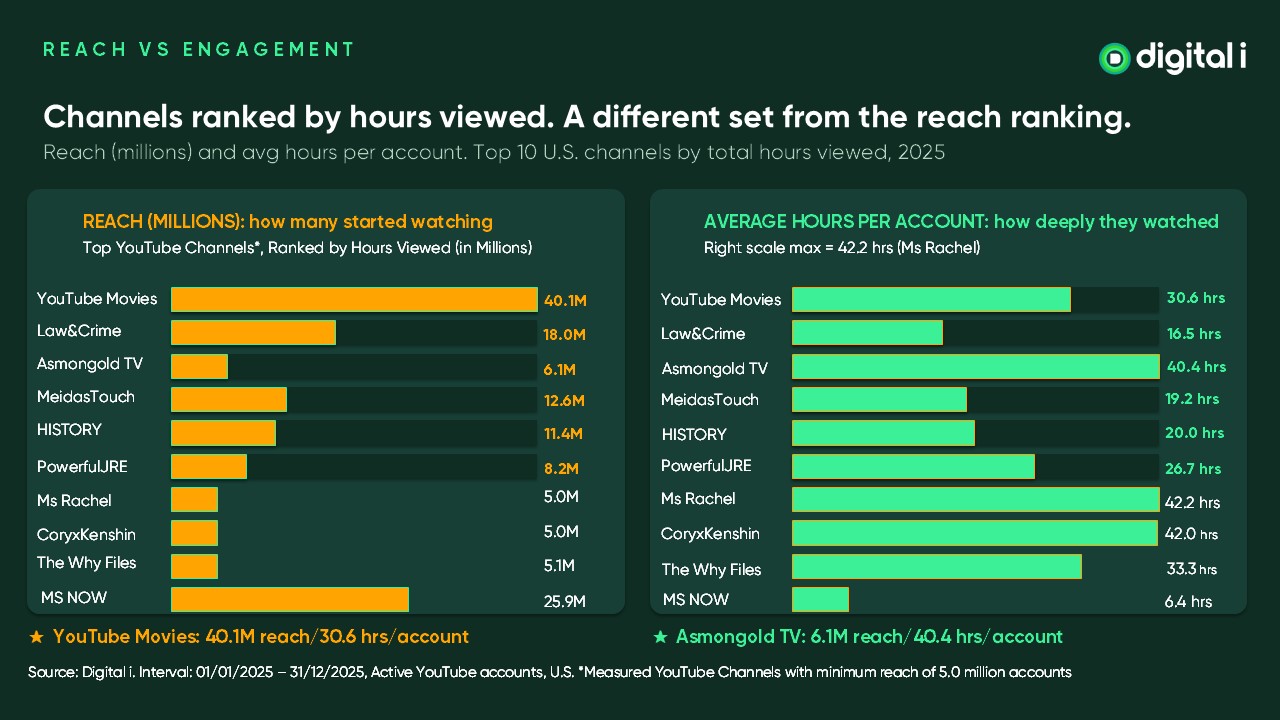
Rank the same U.S. market by hours viewed rather than reach, and a different set of channels appears. Asmongold TV, a gaming channel with 6.1 million account reach, generated 245.8 million hours at 40.4 hours per account. Ms Rachel, an education channel with 5.0 million reach, generated 212.2 million hours at 42.2 hours per account. CoryxKenshin, another gaming channel, reached 5.0 million accounts and averaged 42.0 hours. The Why Files, a science and technology channel, reached 5.1 million accounts and averaged 33.3 hours.
These are not comparable numbers. A channel that reaches 30 million accounts and generates 0.4 hours per account is doing something structurally different from a channel that reaches 6 million accounts and generates 40 hours per account.
What each signal is actually measuring
Reach on YouTube measures how many accounts encountered the channel at least once during the year. For a major entertainment brand running trailers, clips, and promotional content, reach is coherent with the purpose: broad exposure, brand recognition, driving users toward the primary service.
Netflix's YouTube channel is a sampling surface. Its 0.4 annual hours per account reflects that. Users arrived, watched a trailer or a clip, then moved on - likely back toward Netflix's own app to explore the show or film they'd just seen. That's what a brand channel built for discovery is designed to produce: exposure that sends people elsewhere to actually watch.
Hours per account measures something closer to loyalty. The channels generating 30-plus hours per account are not broad-funnel surfaces. They are destinations that specific audiences return to repeatedly, for long-form content, over an extended period. The behavioural profile is closer to a subscription service than a marketing channel.
Both signals are real. Neither is better. But they are not interchangeable. Reach and hours per account are not measuring the same thing. They reflect two different commercial objectives.
What this means for how SVODs evaluate their YouTube footprint
The reach-led channels in the U.S. top ten are predominantly traditional media brands. NBCUniversal holds four of the top ten traditional-media slots globally, alongside Netflix, The Walt Disney Company, Warner Bros. Discovery, and Amazon.
They have succeeded at putting their content in front of large audiences. The data does not tell us whether that reach is converting to subscriptions, driving title awareness, or generating measurable downstream value. It tells us the exposure happened.
The engagement-led channels have built audiences that return repeatedly and for extended sessions. They have built audiences that return voluntarily, repeatedly, and for extended sessions. That is a different kind of platform relationship - often a younger, digital-native audience in high demand from advertisers and traditional media companies alike. YouTube's own data can show that engagement. Understanding how that audience also behaves across the streaming services it uses requires visibility beyond YouTube alone."
Reach tells you whether a brand is present on YouTube. Hours per account tells you whether audiences have decided to stay. For streaming platforms evaluating what their YouTube investment is actually producing, the second number is the less visible one.
How Digital i measures this
Digital i tracks actual viewing behaviour across YouTube and global SVOD services in more than 20 countries. Our methodology is built on an opt-in, consenting panel of statistically representative SVOD users, the same foundational approach as BARB and, covers channel-level YouTube data alongside programme-level data for Netflix, Prime Video, Disney+ and Max.
As our panel is independent and not affiliated with any platform, the data applies the same measurement methodology across both YouTube and SVOD, making the numbers comparable from a single source rather than stitched together from separate outputs.
For streaming platforms trying to understand how YouTube viewing fits into the broader competitive picture, that consistency is what makes the analysis useful.
Book a consultation
Digital i can show you what the hours-per-account data looks like for your biggest competitor's channel or your biggest fan channel alongside the broader competitive picture.